
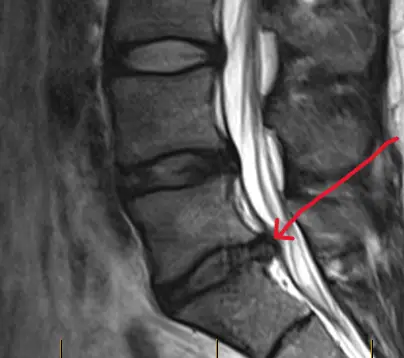
Many people with back pain or sciatica ask whether chiropractic care can help a bulging disc. The short answer is: it may help in the right case, but treatment should always begin with a careful clinical examination.
A bulging disc on an MRI does not always mean it is the cause of your pain. Disc bulges are common, and many people have them without any symptoms at all. However, when a disc is irritating a nerve, it may contribute to symptoms such as back pain, leg pain, or sciatica.
First, it helps to understand what a bulging disc actually is
A bulging disc is different from a disc herniation. With a bulge, the disc extends more broadly beyond its usual boundary. With a herniation, the disc material pushes out more focally through the outer fibres.
That distinction matters, because many people are told they have a “bulging disc” when the more important question is actually this: is the disc causing symptoms, and is a nerve involved?
If you want to understand that difference in more detail, see our article on disc herniation vs bulging disc.
When can a bulging disc cause symptoms?
A bulging disc may contribute to symptoms when it is associated with inflammation, nerve irritation, or increased sensitivity in the surrounding tissues.
Symptoms may include:
- low back pain
- pain into the buttock or leg
- sciatica
- pins and needles
- numbness
- muscle weakness
Leg pain, altered sensation, or weakness usually needs especially careful assessment, because these features may suggest nerve root irritation rather than simple back pain alone.
How chiropractic care may help
Chiropractic care does not “push the disc back into place.” That is a common misunderstanding.
What treatment may do is help reduce mechanical irritation, improve movement in the surrounding spinal joints, decrease muscle guarding, and guide you on what to do — and what to avoid — while the area settles down. In some cases, gentle manual therapy may be appropriate as part of a broader management plan that also includes advice, movement, and exercises.
Depending on the presentation, treatment may include:
- careful hands-on treatment to areas around the irritated segment
- mobility work for stiff spinal joints
- advice on sitting, bending, lifting and walking
- simple exercises chosen for your presentation
- monitoring for signs that imaging or specialist referral may be needed
Not every disc presentation should be manipulated
This is the key point.
If your pain pattern, movement responses, or neurological signs suggest that the disc is highly irritated, spinal manipulation may not be the right choice at that stage. A competent clinical examination should help determine:
- whether a disc injury is likely
- whether a nerve root may be involved
- whether symptoms are stable or worsening
- whether imaging or referral is required
In other words, good chiropractic management is not about forcing treatment onto every patient. It is about choosing the safest and most appropriate approach for the individual in front of you.
Do bulging discs get better with time?
Often, yes.
Many disc-related episodes improve with conservative care, and many people recover without injections or surgery. Recovery time varies. Some people improve over a few weeks, while others take longer depending on the severity of the irritation, whether leg pain is present, and how sensitive the area has become.
It is also worth remembering that symptoms often improve before the disc has fully settled structurally. So the goal early on is usually to reduce irritation, maintain function where possible, and gradually build tolerance again.
When should you seek further assessment?
You should seek prompt assessment if you have:
- significant leg pain
- worsening numbness
- progressive muscle weakness
- pain that is not settling
- symptoms that are severe enough to limit walking, standing, or sleeping
In these cases, imaging such as MRI may sometimes be appropriate — but not every bulging disc requires a scan. Imaging should support the clinical picture, not replace it
The bottom line
A chiropractor may be able to help with a bulging disc, but not because the disc is being “put back in.” The real value lies in accurate assessment, sensible treatment selection, and guiding recovery safely.
At Farrelly Chiropractic in Narre Warren, we assess whether your symptoms are more likely to be coming from a disc, a joint, a nerve, or another structure altogether. From there, we can decide whether conservative care is appropriate and when referral or imaging may be necessary.
FAQs
Can a chiropractor help a bulging disc?
Yes, in some cases chiropractic care may help by improving movement, reducing irritation, and guiding recovery. A proper assessment is important first.
Do bulging discs always cause pain?
No. Many bulging discs are seen on MRI in people with no symptoms at all.
Is a bulging disc the same as a herniated disc?
No. A bulging disc is usually broader, while a herniated disc is more focal.
When should I get an MRI for a bulging disc?
MRI may be considered when symptoms are severe, persistent, or associated with worsening numbness or weakness.